
Published 27 Sep 2026 · Last reviewed 27 Sep 2026 · 6 min read
In short: Before paying token money, independently verify ownership, authority to sell, the title chain, encumbrances, approved land use and plans, RERA disclosures where applicable, dues, possession documents and every payment or cancellation term in writing.
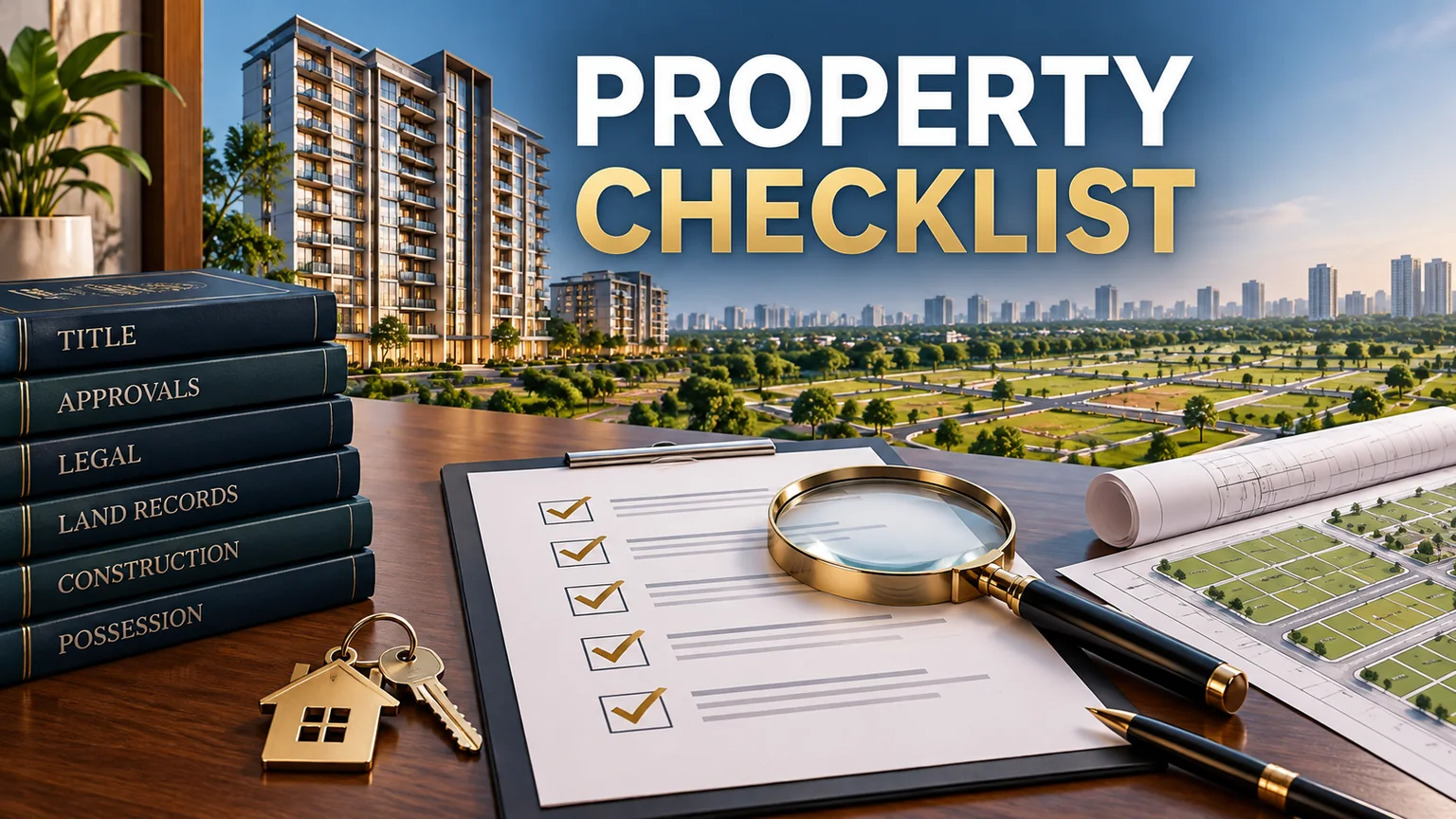
Quick answer: what should you check before paying token money?
Do not treat a brochure, WhatsApp promise, bank approval or RERA number as proof that a property is legally safe. Before transferring even a small token amount, match the seller’s identity with the ownership record, trace the title chain, search for mortgages and disputes, verify permitted land use and sanctioned plans, inspect applicable RERA disclosures, and get the proposed agreement and refund conditions reviewed in writing.
The exact documents vary by state, property type and transaction history. A developer flat, resale apartment, authority plot and agricultural land do not follow the same checklist. Use this guide to organise due diligence, then have an independent property lawyer and tax professional check the actual transaction.
The 15-document property buying checklist
1. Seller identity and authority to sell
Match the seller’s PAN, address and identification with the title document. If a company, trust, legal heir, attorney holder or co-owner is selling, verify the relevant incorporation, succession, board-resolution or registered power-of-attorney records.
2. Current title deed
Obtain the registered document through which the seller acquired the property. Names, measurements, boundaries, survey or khasra numbers and registration details must match the property offered.
3. Complete chain of title
The latest deed alone is not a complete title check. Ask a lawyer to trace earlier transfers, inheritance, partition, conversion and name variations for an appropriate historical period. Missing or unregistered links require investigation.
4. Encumbrance and litigation search
Obtain the state-specific registration or encumbrance search and conduct court, revenue and authority searches. An encumbrance certificate may not reveal every private claim, pending dispute, unregistered arrangement or security interest.
5. Land and revenue records
For plots and land, match khata, khatauni, khasra, jamabandi, record of rights, mutation entries and cadastral map as applicable. Mutation is generally a revenue or municipal update—not a substitute for a valid title deed. Confirm boundaries and legal access through a survey.
6. RERA registration and disclosures
For a project covered by RERA, search the official state or Union Territory portal. Match the project phase, promoter, land details, completion timeline, approved plans, updates, agents, complaints and orders. Absence of a listing needs a reasoned check because some projects can be exempt or outside the Act.
7. Sanctioned building or layout plan
Compare the unit, tower, floor or plot with the plan sanctioned by the competent authority. A marketing plan is not an approval. Confirm use, setbacks, area, access and revisions.
8. Land-use, conversion and development approvals
Confirm that zoning permits the proposed residential, commercial, industrial or agricultural use. Inspect change-of-land-use, coloniser, environment, fire, height or other approvals where applicable. Nearby construction does not legalise a site.
9. Allotment letter and agreement for sale
Read the complete draft before paying a non-refundable amount. Check total consideration, carpet or plot area, specifications, possession, cancellation, refund, interest, maintenance, parking, common areas and dispute clauses. Section 13 of RERA says a promoter cannot accept more than 10% of the cost as advance or application fee without first entering into a written and registered agreement for sale.
10. Payment schedule and complete cost sheet
Ask for a signed cost sheet separating price, charges, deposits, taxes, stamp duty, registration and brokerage. Every token payment needs a receipt identifying the parties, property, amount, purpose and refund conditions.
11. Loan, mortgage and lender release
If mortgaged, obtain the loan position and written closure process. Structure payment so the lender safely releases its charge and originals. Bank approval of a project does not replace your due diligence.
12. Tax, society, authority and utility dues
Collect current tax receipts and statements for maintenance, utilities, ground or lease rent and authority charges. For leasehold property, check transfer permission, lease conditions and outstanding instalments.
13. Completion and occupancy documents
For completed buildings, verify the completion and occupancy certificates or state-specific equivalents with the issuing authority. Ensure the certificate covers the correct tower or phase and matches actual construction.
14. Possession, society and resale papers
For resale, inspect the possession letter, prior receipts, society or association records, parking allocation, dues, inheritance records and vacant-possession terms. Record fixtures and defects in writing.
15. Draft sale deed, taxes and registration plan
Review the draft deed before execution. It must accurately state parties, title history, consideration, property, possession, representations, indemnities and originals handed over. Calculate stamp duty, registration and buyer-side tax compliance using the law and official portal applicable on the payment date. Tax procedures changed from 1 April 2026, so an old article or form number may be wrong.
Red flags that justify stopping
- Pressure to pay immediately or refusal to issue an independently reviewed receipt.
- Different names, areas, boundaries, khasra numbers or project phases across records.
- Unavailable originals without a credible lender-controlled explanation.
- Advertised use that conflicts with zoning or sanctioned plans.
- Unexplained RERA delays, complaints, orders or altered approvals.
- Cash consideration, undervaluation or a different deed price.
- Resistance to a lawyer, surveyor or official-record search.
A safe sequence before payment
- Record the exact property, seller and all-in price.
- Collect legible documents and official portal references—not screenshots alone.
- Match identity, ownership, description, area and approvals.
- Search registration, land, court, RERA, authority and charge records.
- Inspect the site against the sanctioned plan; use a surveyor or engineer where needed.
- Obtain an independent written title and agreement review.
- Document token refund conditions, lender closure and milestones.
- Register the correct deed and preserve originals and digital copies.
Special checks by property type
Under-construction apartment
Prioritise the exact RERA phase, sanctioned plan, title disclosure, milestones, agreement and completion timeline.
Ready-to-move or resale apartment
Prioritise title chain, occupancy documents, society records, dues, alterations, mortgage release and vacant possession.
Plot or agricultural land
Prioritise revenue records, access, demarcation, land use, conversion, acquisition notices and buyer eligibility under state law.
Authority or leasehold property
Prioritise allotment and lease deeds, transfer permission, instalments, ground rent, permitted use and authority dues.
What RERA verification does—and does not—prove
RERA improves disclosure and accountability. Applicable filings include information about title, encumbrances, sanctioned plans, proposed agreements and timelines. But a registration number is not a personal legal opinion on your unit, seller, title chain or contract. Use RERA as one important evidence source within broader due diligence.
Sources and review methodology
Central legislation and official government portals were prioritised, with Uttar Pradesh examples because MyInvestorGuru covers Delhi NCR. Rules vary by state and property type. Sources checked on 27 September 2026.
- India Code — Real Estate (Regulation and Development) Act, 2016
- Ministry of Housing and Urban Affairs — FAQs on RERA
- UP Stamp and Registration Department — Property Search
- Registration Act, 1908 — official UP portal copy
- Income Tax Department — TDS compliance and 2026 transition
Author: MyInvestorGuru Editorial Team. Legal reviewer: [Name, qualification and enrolment details to be added before publication]. Editorial reviewer: [Name and role to be added].
Frequently asked questions
What documents should I check before paying token money?
Verify seller authority, title deed and chain, encumbrances, land records, sanctioned plans, permitted use, RERA disclosures where applicable, dues, mortgage status and the draft agreement with written refund terms.
Does RERA registration guarantee that a property is legally safe?
No. It provides important disclosures and accountability, but does not replace an independent title search, contract review, approval verification and inspection.
How much advance can a promoter take before an agreement for sale?
Section 13 of the central RERA Act says a promoter cannot take more than 10% of the cost without first entering into a written and registered agreement for sale. Check the applicable state rules and documents.
Is a bank-approved project automatically safe?
No. A lender’s approval reflects its own process. Buyers still need independent verification of title, approvals, contract terms, dues and the exact unit or plot.
Is an encumbrance certificate enough to prove clear title?
No. It is useful but may not reveal every dispute, private claim, unregistered arrangement or possession issue. Combine it with title-chain, court, land, authority and charge searches.
Can token money be refunded if the title check fails?
That depends heavily on the written receipt or agreement. State due-diligence and refund conditions clearly and have the wording reviewed before payment.
property buying checklist Indiadocuments to check before buying propertyRERA verificationproperty title verificationtoken money
Last reviewed: September 2026 · We broker land in Delhi NCR, so treat anything about specific plots as a commercial interest. Verify title, approvals and measurement independently. See Disclaimer.